TheySaid review
Is TheySaid worth it? What its AI synthetic testers can and can't tell designers, what the free plan includes and how it compares with Maze (Nov 2026).
 Sketch Focus Editorial Team
Research-based reviewNot yet tested hands-on · facts checked Nov 24, 2026How we test
Free
Free plan available
Our take so far
TheySaid looks like a quick way to get a usability read on a prototype without leaving Claude, Cursor or Lovable, and the free plan covers 5 AI user tests a month. The catch: synthetic testers are a first pass, not user research, and even TheySaid says they can't judge emotion, trust or accessibility.

TheySaid
At a glance
Not scored yet. We only score tools after hands-on testing.
- What it is
- AI user testing with synthetic testers and real users
- Free plan
- Yes
- Paid from
- Free
- Tests
- Live sites, Figma prototypes, iOS and Android apps
- Testers
- Synthetic testers, your users, recruited panel
- Also runs
- AI interviews, surveys, forms and polls
- MCP
- Claude, Cursor, v0, Lovable, Bolt, Replit
- Tickets
- Auto-tests from Jira, Linear, ClickUp, monday.com
- Figma
- Prototype links as test input; no plugin stated
- Made by
- TheySaid, Inc. (Lehi, Utah)
TheySaid pricing
Free
For trying AI user testing
$0/mo
- 5 AI user tests a month
- Synthetic testers and AI moderator
- 1 workspace, 1 active test
- Invite your own users free
Enterprise
For teams testing at scale, billed annually
Custom
- Unlimited synthetic and panel recruiting
- Interviews, surveys, polls and user tests
- SSO/SAML, API and webhooks
- Dedicated account manager
Free covers 5 AI user tests a month. The homepage says synthetic tests start at $1 each, but the pricing page lists only Free and custom-priced Enterprise, so no paid self-serve price is published. Prices from theysaid.io, checked Nov 24, 2026. Plans change often, so confirm before you buy.
What TheySaid is
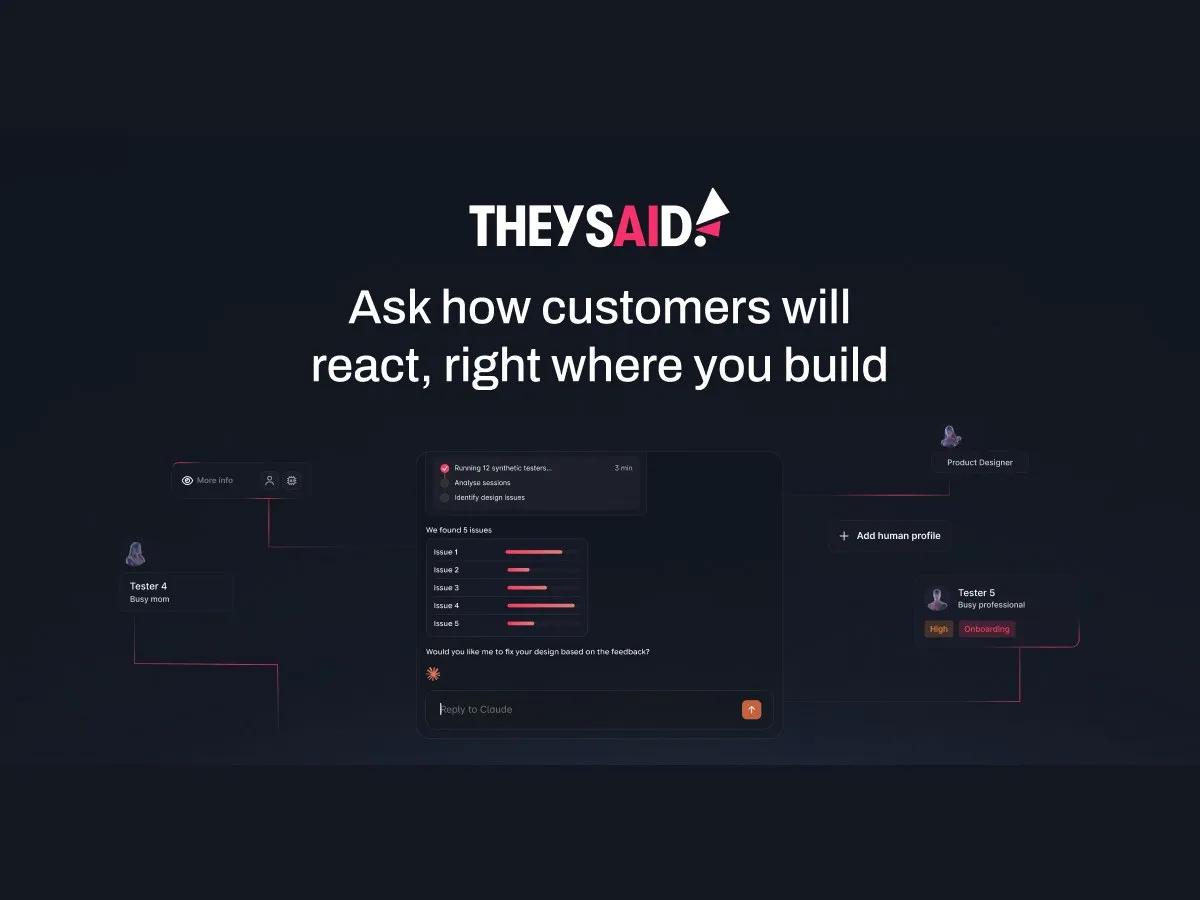
TheySaid is worth trying if you build in Claude, Cursor or Lovable and want a fast first read on whether people can use what you’ve made. It’s an AI user testing platform, just don’t mistake its AI testers for real users. Synthetic testers (AI personas) click through your design while recording the screen and thinking aloud, and you get a ranked list of issues back in minutes.
TheySaid first launched on Product Hunt as a conversational survey tool in August 2024, and it still runs AI-moderated interviews, surveys, forms and polls with real people. Version 4.0 launched on Product Hunt on 27 October 2026, where it was the top product of the day. It added the synthetic testers, an MCP server and automatic tests triggered by tickets. The company behind it is TheySaid, Inc., based in Lehi, Utah.
What designers can do with it
The synthetic testers and the MCP link are the reasons a designer would look at TheySaid; the rest is a solid but familiar research toolkit. Ranked by how much each matters:
- Synthetic usability tests (headline feature). You describe what you want to learn, AI writes the tasks, and synthetic testers work through a live URL, staging site, Figma prototype or iOS and Android app. TheySaid says they hesitate, get confused and explain why out loud. There’s a Fast Mode for a quick read and a Full Mode for a complete session.
- Tests from inside your build tool (headline feature). The MCP server (a standard way for AI tools to call other services) lets you launch a test from Claude, Cursor, v0, Lovable, Bolt or Replit. TheySaid says AI proposes a test plan and nothing runs until you approve it. Each issue comes back with a fix prompt to paste into your build tool, which suits a prompt-and-iterate workflow well.
- Personas you can tune (useful). You set demographics, tech savviness and behaviour for each profile and run several at once. TheySaid says testers start from a model trained on 100,000+ hours of real sessions, then learn from your customer data.
- Ticket Testing (useful for product teams). When a Jira, Linear, ClickUp or monday.com ticket reaches “Design Done”, a test runs and the results land on the ticket. That’s handy if design reviews tend to get skipped.
- Real participants (solid, not new). You can share tests with your own users by link, email, popup, embed or QR code, or recruit from TheySaid’s panel. Surveys and interviews run in 70+ languages.
- Clips and reports (expected). Highlight reels, severity ratings, task completion and first-click accuracy are all there. Most testing tools we cover offer something similar.
- Weak spot: Figma is just a link. Figma prototypes work as a test input, but TheySaid describes no Figma plugin, and its 4.0 page doesn’t mention Figma at all.
How good are AI testers?
This is the question that matters, and the short answer is that nobody independent has measured TheySaid’s testers yet. What exists is the vendor’s own evidence plus broader research on synthetic users, which is cautious about them in general.
TheySaid’s homepage claims that across “10+” side-by-side studies, synthetic testers found 89% of issues and humans 90%. TheySaid links its method as a PDF, which we haven’t reviewed. Its one published case study is narrower: 25 US shoppers and 25 matched synthetic testers comparing two vacuums on Amazon. Of the 25 synthetic testers, 21 chose the same brand as their human match. But the synthetic study covered only 70% of the human study’s major findings, and fully matched only 50%. TheySaid’s own write-up says humans “added real-world nuance”.
Independent researchers are more sceptical. Nielsen Norman Group (Maria Rosala and Kate Moran, June 2024) compared synthetic interviews with three real studies and found the answers shallow and too positive. In one case, synthetic users said they’d finished online courses that real learners had abandoned. In October 2026, NN/g’s Rachel Banawa found synthetic respondents matched the headline result of a 604-person survey. They gave about a dozen distinct answers where humans gave more than 50, and smoothed out differences between job roles.
Two caveats apply. Those NN/g studies tested synthetic interviews and surveys, not AI agents clicking through an interface, which is what TheySaid’s testers do. And researchers themselves remain wary: in User Interviews’ May 2026 survey of 150 researchers, about 47% called themselves sceptical and only 3% enthusiastic. Insight quality was the top concern, named by 88%.
Synthetic testers show you where to look. Real users show you what you missed.
Customer reviews are positive, but only one we found mentions synthetic testers. TheySaid scores 5.0 from 42 ratings on Capterra and 4.8 from 94 reviews on G2 (both checked 24 November 2026). Reviewers praise quick setup and AI summaries, and criticise limited report customisation and a learning curve. Only one Capterra review we found mentions synthetic users: it says they sped up product-page reviews but gave less control over specific scenarios.
The real cost
The free plan is genuinely usable, but the paid price is unclear. As of 24 November 2026, the pricing page lists two plans:
- Free: $0, no card. 5 AI user tests a month, one workspace, one active test. Synthetic testers, the AI moderator and AI reporting are included, and responses from your own users aren’t capped per test.
- Enterprise: custom pricing, billed annually. Unlimited synthetic and panel recruiting, interviews and polls, SSO, API and webhooks, and CRM integrations.
The homepage adds a figure the pricing page doesn’t explain: synthetic tests start at “$1” each. Hard-to-find testers such as doctors or business owners cost extra, with no figure given. Interviews, surveys, chat and polls are Enterprise-only, so on Free you get AI user tests alone.
TheySaid’s own pages also disagree in places. The Free plan says you can recruit from the panel for an extra fee, while the FAQ says panel access is Enterprise only. The pricing FAQ puts the panel at 16M+ people, while a guide updated the day before our check says 5M+. That guide still lists AI testers as “coming soon”.
Our advice: use the Free plan’s five tests on a real prototype and judge the reports yourself. Don’t plan a budget around $1 per test until sales confirms how you’d buy it.
Where it falls short
The main weakness is the one every synthetic tester shares: it can spot a hard-to-find button, not whether customers trust you.
- TheySaid lists the limits itself. Its synthetic testing guide says LLMs are “trained to be helpful and agreeable” and that B2B and specialist audiences are poorly modelled. It adds that emotion, trust and brand perception can’t be simulated, and that “Accessibility testing is impossible”. That candour is to its credit, but it narrows what you can use the testers for.
- No independent accuracy data. The 89% figure is the vendor’s own, and the published case study is a shopping task, not a UI test.
- Unclear paid pricing. There’s no self-serve paid plan on the pricing page.
- AI output is your responsibility. The Terms say outputs may be “inaccurate, incomplete, misleading, or biased” and that you must review them.
- Security is stated, not detailed. The security page says TheySaid follows SOC 2 criteria without naming a report type, and ISO 27001 is “soon”. On data, the Terms say customer data isn’t used to train AI. Anthropic is the main model provider, with OpenAI as fallback, and data is hosted on Google Cloud in the US.
TheySaid vs Maze
They suit different stages: TheySaid is the faster first pass, and Maze is the better tool for testing with real people. Maze centres on Figma prototype tests, card sorting and tree testing with its 20M+ participant panel. Its Free plan allows one study a month and has no AI features, and its AI Moderator and MCP server are Enterprise extras. Our Maze review has the details, checked 22 November 2026.
TheySaid’s Free plan includes AI moderation and five AI user tests a month with synthetic testers. Its MCP also works from the build tools many designers now use, such as Lovable, v0 and Cursor. Maze’s pages list no synthetic testers. On cost per real participant, Maze’s credit bundles ($250 for 50 credits, 3 credits for an unmoderated consumer response) work out at about $15 a response by our arithmetic, inside TheySaid’s own $12–24 range for human testers.
A sensible split is to catch the obvious problems with TheySaid while you iterate. Then run the final round with real people in Maze or another tool from our usability testing tools list.
Should you use TheySaid?
Yes, if you prototype in Claude, Cursor, Lovable or v0, you test rarely because recruiting is slow, and you want a quick check for confusing flows before showing anyone.
Not yet, if you need evidence for a launch decision, accessibility findings, B2B or specialist audiences, or a fixed price you can put in a budget.
How we reviewed TheySaid
This review is based on research, not on our own hands-on test. In we checked TheySaid’s homepage, pricing, 4.0, feature and designer pages, its case study and two blog guides. We also read its security page, Terms, Privacy Policy and data processing agreement. Beyond TheySaid, we read Nielsen Norman Group’s research on synthetic users, Blink UX’s guidance and User Interviews’ researcher survey. Customer reviews came from Capterra, G2, Trustpilot and Product Hunt. Prices and features come from TheySaid’s own pages, and we’ve flagged where they disagree. The opinions are our editors’ judgement based on that research.
Next, we’ll run the same Figma prototype through TheySaid’s synthetic testers and through five real participants, then compare which issues each group finds. See how we test, and more research tools in our UX research hub.
Sources we checked
- TheySaid: homepage (opens in new tab), pricing (opens in new tab), TheySaid 4.0 (opens in new tab), AI testers (opens in new tab), for designers (opens in new tab), product releases (opens in new tab)
- TheySaid: Human vs. Synthetic Testers case study (opens in new tab)
- TheySaid blog (Chris Hicken, updated 23 November 2026): synthetic user testing guide (opens in new tab), AI user testing guide (opens in new tab)
- TheySaid legal and security: security (opens in new tab), privacy policy (opens in new tab), terms (opens in new tab), DPA and subprocessors (opens in new tab), participant privacy notice (opens in new tab)
- TheySaid 4.0 press release (opens in new tab) (3 November 2026)
- TheySaid connector in the Claude directory (opens in new tab)
- TheySaid on Product Hunt (opens in new tab)
- Synthetic Users: If, When, and How to Use AI-Generated “Research” (opens in new tab) (Nielsen Norman Group, Maria Rosala and Kate Moran, 21 June 2024)
- Synthetic Users vs. Human Respondents (opens in new tab) (Nielsen Norman Group, Rachel Banawa, 16 October 2026)
- Evaluating AI-Simulated Behavior (opens in new tab) (Nielsen Norman Group, Raluca Budiu, 15 August 2025)
- Real vs Synthetic: Why Humans Still Matter for Usability (opens in new tab) (Blink UX, Kristen Althizer, 15 July 2026)
- The State of Synthetic Users (opens in new tab) (User Interviews, survey fielded May 2026)
- Reviews: Capterra (opens in new tab), G2 (opens in new tab), Trustpilot (opens in new tab)
Alternatives to TheySaid
See all →
Maze
User research platform for testing Figma prototypes
Update history
How we keep pages current- Pricing re-checked on theysaid.io: the Free plan is now 5 AI user tests a month, and surveys, interviews and polls moved to Enterprise. Removed per-tester prices the site no longer shows.
First published
Frequently asked questions
Is TheySaid free?
Yes. The Free plan costs $0 with no credit card and includes 5 AI user tests a month, one workspace and one active test. It includes synthetic testers, the AI moderator and AI reporting, and you can invite your own users at no cost. Interviews, surveys and polls need Enterprise.
How much does TheySaid cost?
TheySaid's homepage says synthetic tests start at $1 each. The pricing page, though, lists only Free and Enterprise, which is custom-priced and billed annually. As of November 2026 there's no published self-serve paid plan, so ask sales before you budget.
What are synthetic testers?
They're AI personas that click through your site, prototype or app while recording the screen and thinking aloud. TheySaid says its base model was trained on 100,000+ hours of usability sessions and then learns from your customer data. You set demographics, tech savviness and behaviour for each profile.
Can AI synthetic users replace real usability testing?
No, and TheySaid says so itself: it calls synthetic testers preliminary validation and says they can't simulate emotion or trust or test accessibility. Nielsen Norman Group's research reaches the same view. Use them to catch obvious problems early, then test with real people before big decisions.
Does TheySaid work with Lovable, v0 or Cursor?
Yes, through the TheySaid MCP server. TheySaid says you can launch tests from Claude Design, Claude Code, Cursor, v0, Replit, Bolt and Lovable, and each issue comes with a fix prompt to paste back into your build tool. Tests can also start automatically when a Jira, Linear, ClickUp or monday.com ticket reaches design done.
Does TheySaid use my data to train AI?
Its Terms and Privacy Policy say no. TheySaid says it doesn't train any model on customer data, and its AI providers (Anthropic as primary, OpenAI as fallback, plus Google) are contractually barred from doing so. Data is hosted on Google Cloud in the United States.